

Derivation of the Mott-Gurney Equation
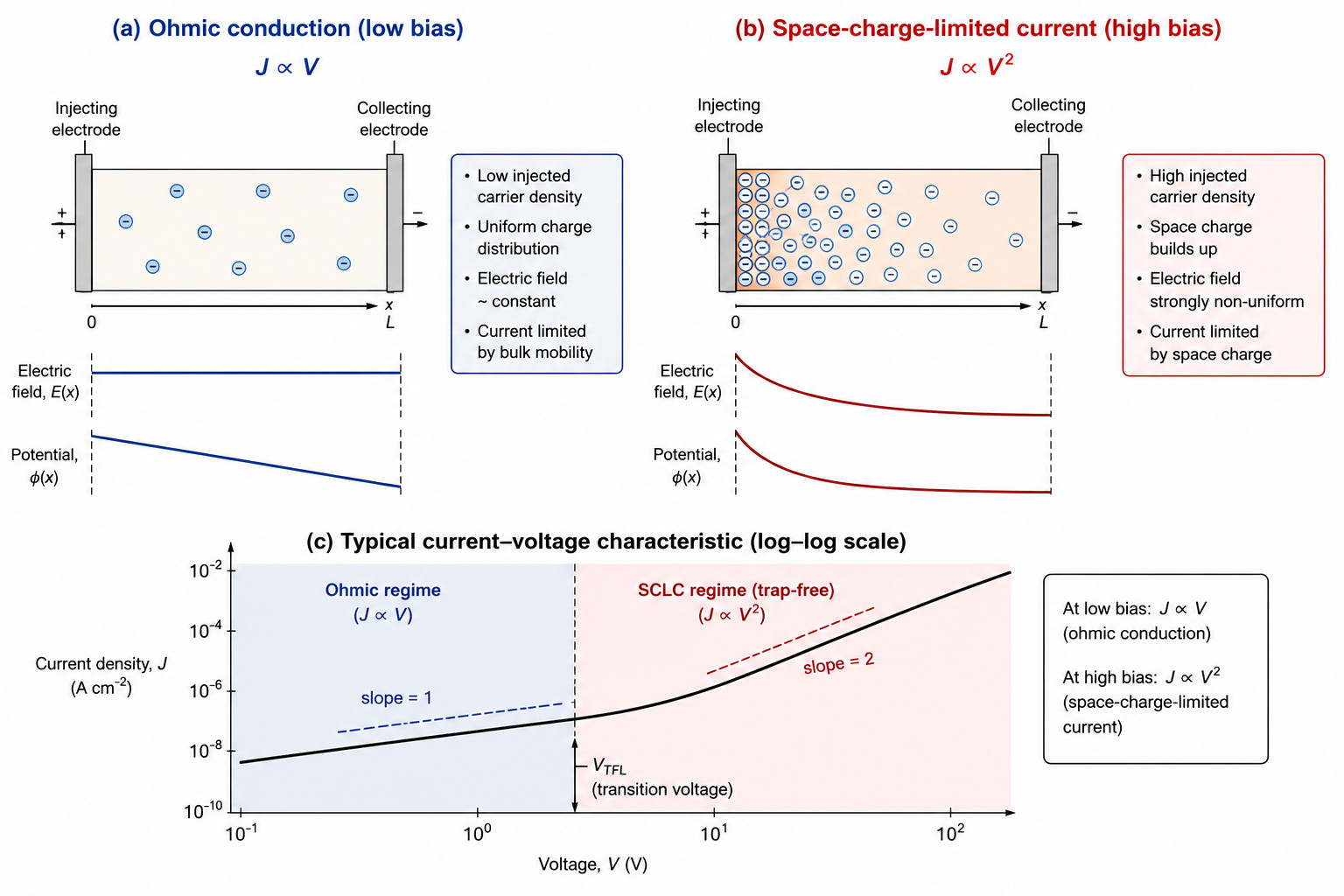
Space-charge-limited current (SCLC) is one of the most important transport regimes in semiconductor device physics. It occurs when the density of carriers injected from the contacts becomes much larger than the equilibrium carrier density already present inside the semiconductor. Under these conditions, the current is no longer limited by the intrinsic conductivity of the material, but instead by the electric field generated by the injected charge itself.
SCLC measurements are widely used in organic semiconductors, OLEDs, perovskite devices, and disordered materials to estimate carrier mobility and investigate trap states. Experimentally, SCLC is usually measured using a hole-only or electron-only structure, where both contacts preferentially inject the same carrier type. This suppresses electron-hole recombination and allows the transport of a single carrier species to dominate.
The most widely known analytical description of trap-free SCLC is the Mott-Gurney equation, which predicts that the current density varies quadratically with applied voltage:
$$ J = \frac{9}{8}\varepsilon\mu\frac{V^2}{L^3} $$
where \(J\) is the current density, \(\varepsilon\) is the permittivity of the material, \(\mu\) is the carrier mobility, \(V\) is the applied voltage, and \(L\) is the device thickness.
Although the equation itself is compact, the physical assumptions behind it are extremely important. The derivation assumes trap-free transport, a single carrier type, ohmic contacts, uniform mobility, negligible diffusion current, and negligible recombination. Understanding these assumptions is essential when interpreting experimental SCLC measurements.
Physical origin of space-charge-limited current
In ordinary ohmic conduction, the carrier density inside the semiconductor is approximately constant and the current density scales linearly with voltage. In this regime the electric field inside the device is nearly uniform and the injected carrier density is relatively small.
However, when a contact efficiently injects carriers into a low-conductivity semiconductor, the injected charge begins to accumulate inside the device. This accumulated charge modifies the internal electric field through Poisson’s equation. As a result, the electric field becomes position dependent and the current becomes limited by the electrostatic interaction of the injected charge itself.
This behaviour is illustrated in ??. Unlike ohmic conduction, the internal field in the SCLC regime is not uniform. Instead, the electric field increases with distance across the device because additional injected charge continuously modifies the electrostatic potential.
Starting equations
The derivation of the Mott-Gurney equation begins with two fundamental equations: Poisson’s equation and the drift current equation.
Poisson’s equation relates the electric field gradient to the charge density:
$$ \frac{dE}{dx} = \frac{\rho}{\varepsilon} $$
where \(E\) is the electric field, \(\rho\) is the charge density, and \(\varepsilon\) is the permittivity of the semiconductor.
Assuming a single carrier species with density \(n\), the charge density becomes:
$$ \rho = qn $$
where \(q\) is the elementary charge.
The drift current density is given by:
$$ J = q\mu nE $$
where \(\mu\) is the carrier mobility.
In the Mott-Gurney derivation, diffusion current is neglected. This approximation is valid when the electric field is sufficiently strong that drift transport dominates over diffusion.
The full drift-diffusion equation is:
$$ J = q\mu nE + qD\frac{dn}{dx} $$
but under SCLC conditions the diffusion term is assumed to be small compared with the drift term:
$$ qD\frac{dn}{dx} \ll q\mu nE $$
Derivation of the Mott-Gurney equation
We begin by combining Poisson’s equation with the drift current equation. Substituting:
$$ n = \frac{\varepsilon}{q}\frac{dE}{dx} $$
into the drift current expression:
$$ J = q\mu nE $$
gives:
$$ J = q\mu \left( \frac{\varepsilon}{q}\frac{dE}{dx} \right) E $$
which simplifies to:
$$ J = \varepsilon\mu E\frac{dE}{dx} $$
Rearranging:
$$ E\,dE = \frac{J}{\varepsilon\mu}\,dx $$
Integrating across the device:
$$ \int_0^{E} E\,dE = \frac{J}{\varepsilon\mu} \int_0^x dx $$
gives:
$$ \frac{E^2}{2} = \frac{Jx}{\varepsilon\mu} $$
Therefore:
$$ E(x) = \sqrt{ \frac{2Jx}{\varepsilon\mu} } $$
The voltage across the device is obtained by integrating the electric field:
$$ V = \int_0^L E(x)\,dx $$
Substituting the field expression:
$$ V = \int_0^L \sqrt{ \frac{2Jx}{\varepsilon\mu} } \,dx $$
Taking constants outside the integral:
$$ V = \sqrt{ \frac{2J}{\varepsilon\mu} } \int_0^L x^{1/2}\,dx $$
Performing the integration:
$$ V = \sqrt{ \frac{2J}{\varepsilon\mu} } \cdot \frac{2}{3}L^{3/2} $$
Squaring both sides:
$$ V^2 = \frac{8JL^3}{9\varepsilon\mu} $$
Finally, rearranging for the current density gives the Mott-Gurney equation:
$$ J = \frac{9}{8} \varepsilon\mu \frac{V^2}{L^3} $$
Physical assumptions behind the derivation
Although the derivation appears mathematically straightforward, it depends on several important physical assumptions.
Trap-free transport
The derivation assumes that all injected carriers remain mobile and contribute directly to electrical transport. In real disordered semiconductors, carriers are frequently trapped in localized states. Trapping modifies the carrier distribution and changes the voltage dependence of the current.
Single-carrier transport
The Mott-Gurney equation assumes that only one carrier type contributes significantly to transport. In bipolar devices containing both electrons and holes, recombination and charge neutrality effects invalidate the simple SCLC derivation.
Ohmic contacts
The derivation assumes that carriers can be injected freely into the semiconductor. If a Schottky barrier or injection barrier exists at the contact, the current becomes limited by contact injection rather than space charge inside the device.
Uniform mobility
The derivation assumes that the mobility is independent of electric field and carrier density. In many organic semiconductors, however, the mobility depends strongly on field, disorder, and trap filling.
Negligible diffusion current
Diffusion transport is neglected throughout the derivation. This approximation becomes less accurate at low electric fields or near equilibrium conditions.
When the Mott-Gurney equation fails
Real semiconductor devices frequently deviate from ideal Mott-Gurney behaviour. One of the most common causes is the presence of trap states. In trap-limited SCLC, the current often follows a power law:
$$ J \propto V^m $$
where \(m > 2\).
Field-dependent mobility can also strongly modify the current-voltage relation. Many disordered organic semiconductors exhibit Poole-Frenkel behaviour, where the mobility increases exponentially with electric field.
At very high voltages, series resistance and self-heating effects may also become important. Similarly, if both electrons and holes are present simultaneously, recombination can alter the electric field distribution and invalidate the single-carrier assumption.
For these reasons, numerical drift-diffusion simulations are often required to accurately describe real semiconductor devices.
Relation to drift-diffusion simulations
The Mott-Gurney equation is extremely useful because it provides analytical insight into space-charge-limited transport. However, real semiconductor devices frequently contain trap distributions, field-dependent mobilities, non-ohmic contacts, recombination processes, and spatially varying electric fields that cannot be captured by a simple analytical model.
Drift-diffusion simulation tools such as OghmaNano solve the coupled Poisson and continuity equations numerically, allowing these non-ideal effects to be included explicitly. This makes it possible to study realistic SCLC devices containing disorder, trap states, mobility gradients, and complex multilayer structures.
Continue to the SCLC simulation tutorial to simulate space-charge-limited current numerically in OghmaNano.