Translate the provided English OghmaNano HTML/PHP page into Brazilian Portuguese by performing a strict, diff-only transformation: preserve all HTML, PHP, structure, order, IDs, classes, scripts, includes, include count, include locations, tables, menus, analytics, schema, and layout exactly as-is; do NOT add, remove, duplicate, reorder, or re-insert any PHP include statements; change to ; if and only if the English page does not already set $lang or include menu_top.html, then immediately after
insert "$lang='pt'; include($_SERVER['DOCUMENT_ROOT'].'/menu_top.html');", otherwise do not add a second include; in the $meta array translate title and description faithfully (no SEO rewriting), change canonical to the /pt/ version, ensure 'lang' => 'pt', and ensure 'i18n_key' exists and is set deterministically to the canonical path WITHOUT the scheme/host and WITHOUT the /pt prefix (i.e., i18n_key = parse_url(canonical,PHP_URL_PATH) with any leading '/pt' removed); keep all other existing meta keys unchanged and do not add or remove any others; translate all visible text into professional, technical Brazilian Portuguese without adding, expanding, enriching, summarising, editorialising, or improving content; use standard physics terminology (drift–diffusion, SRH, transfer-matrix, etc.) while keeping scientific abbreviations (JV, OLED, OFET, EQE, SRH) in Latin characters; convert every localized_url(...,'en') to localized_url(...,'pt') and do not alter other URLs; translate headings, lists, buttons, and duplicated mobile/desktop sections consistently while keeping IDs, styles, emojis, symbols, punctuation, line breaks, and formatting exactly matching the English source; translate “Translations” to “Traduções” and keep get_translations(0) unchanged; do NOT add structured data (JSON-LD), schema, emojis, new sections, new text, new links, new scripts, or metadata that does not already exist in the English source EXCEPT adding 'lang' and the deterministic 'i18n_key' as defined above; output a complete valid HTML file only, with no commentary or explanations. If the English source contains any JSON-LD/schema/script blocks (including application/ld+json), keep them byte-identical (do not translate, do not change URLs, do not add/remove fields), and if the English source does not contain them, do not add them. Put the output in a code block.
Optical Filters Database | OghmaNano User Manual
OghmaNano
Simular células solares orgânicas/Perovskita, OFETs e OLEDs DESCARREGAR
Optical filters database
The ?? shows the Databases ribbon.
By selecting the Filters database, you open the optical filters directory shown in
??. Any filters that are pre-installed or created by the user will appear in this list.
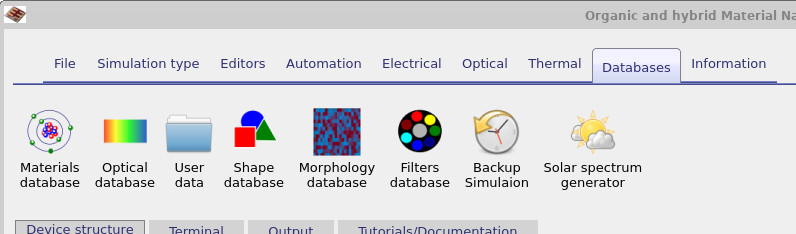
The Databases ribbon in OghmaNano. Selecting the Filters database opens the optical filters database.
The Filters database directory, listing available filters. Double-clicking an item opens its spectrum data.
Double-clicking on the glasses entry opens one of the glass filters, as shown in
??.
The curve shows the apparent reflectance of glass, which increases sharply below about 400 nm.
In practice, glass attenuates light at these shorter wavelengths—some of it is reflected, while the rest is absorbed—so the light never reaches the device.
OghmaNano represents this attenuation as a reflectance spectrum, making it straightforward to model how the filter blocks low-wavelength light.
By applying the filter in front of a device, or multiplying it with an optical spectrum, you can exclude specific regions of the spectrum from your simulation.
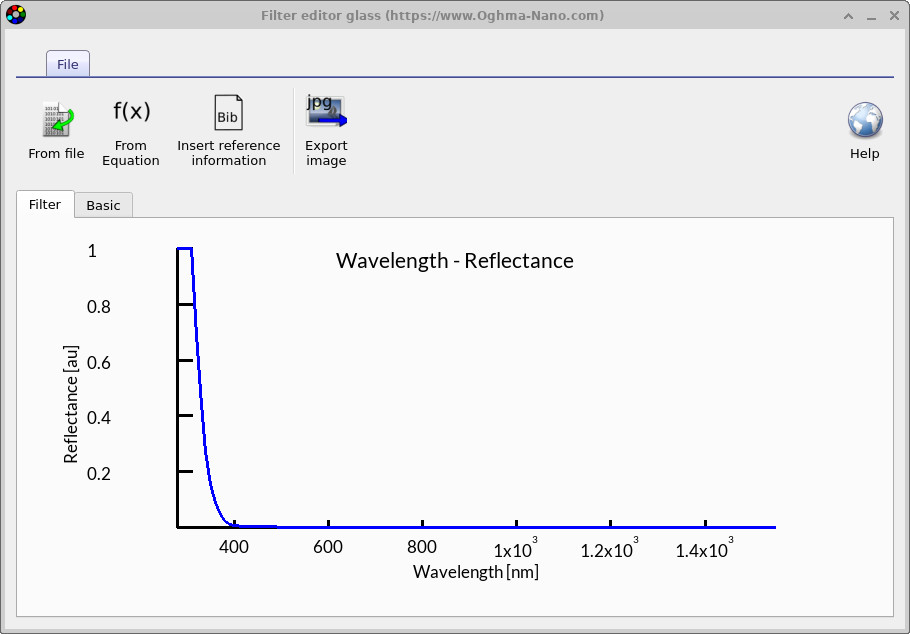
An example filter spectrum, showing Wavelength vs. Reflectance. Values between 0 and 1 represent how much light is reflected or transmitted.
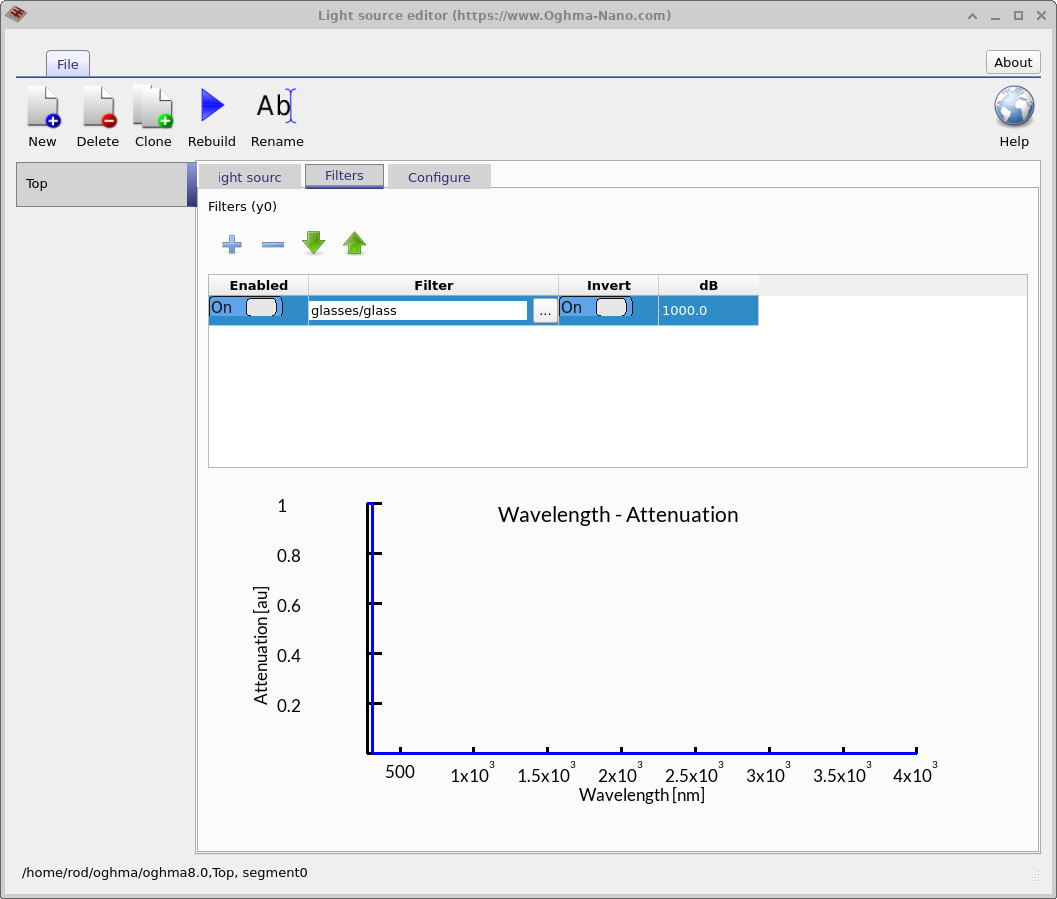
The Light source editor with a filter applied. The attenuation spectrum indicates how the filter modifies the light source.
The ?? illustrates the use of this filter within the
Light source editor. Here, the filter is applied to remove low-wavelength light from the source spectrum.
Within this editor, you can also adjust the attenuation in decibels (dB) or invert the filter response, effectively reversing its effect.
This makes it straightforward to incorporate reflectance or transmission characteristics into your optical simulations by directly multiplying them with the light source spectra.