

Derivation of the Shockley-Read-Hall recombination equation
1. Shockley-Read-Hall (SRH) Recombination in Its Simplest Form
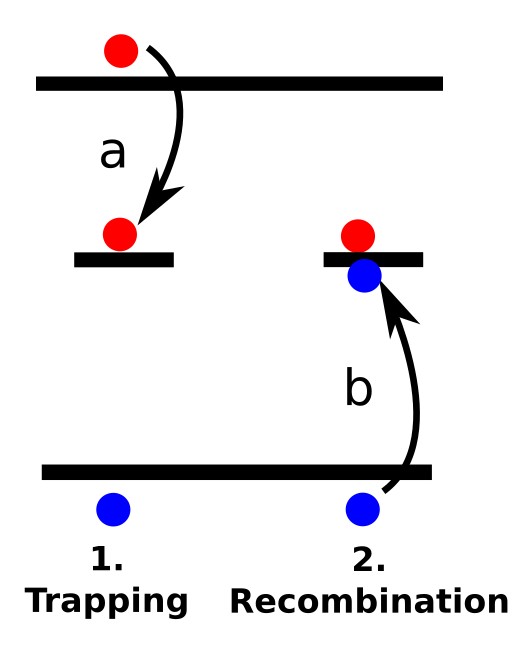
Shockley-Read-Hall (SRH) recombination, in its simplest form, can be understood as the two-step process shown in ??. First, a charge carrier becomes trapped into a localized defect state within the band gap, process (a). A charge carrier of the opposite species then recombines with the trapped carrier through the same trap state, process (b). This simple physical picture leads to the classical SRH recombination equation familiar from semiconductor device physics:
\[ R_{SRH}= \frac{np-n_i^2} {\tau_p(n+n_1)+\tau_n(p+p_1)} \]
However, in the original work of Shockley, Read, and Hall, the physical model was formulated in a much more detailed manner. Rather than considering only trapping followed by recombination, the theory defines four competing carrier transition rates associated with carrier capture and thermal emission processes. These transitions obey detailed-balance conditions at thermal equilibrium and are illustrated in ??.
The four rates are:
- \(r_{ec}\): electron capture into the trap state.
- \(r_{ee}\): thermal emission of an electron from the trap state.
- \(r_{hc}\): hole capture into the trap state.
- \(r_{he}\): thermal emission of a hole from the trap state.
Using these four rates, the occupation of the trap state can be described through the carrier trapping rate equation:
\[ \frac{dn_t}{dt}=r_{ec}-r_{ee}-r_{hc}+r_{he}. \]
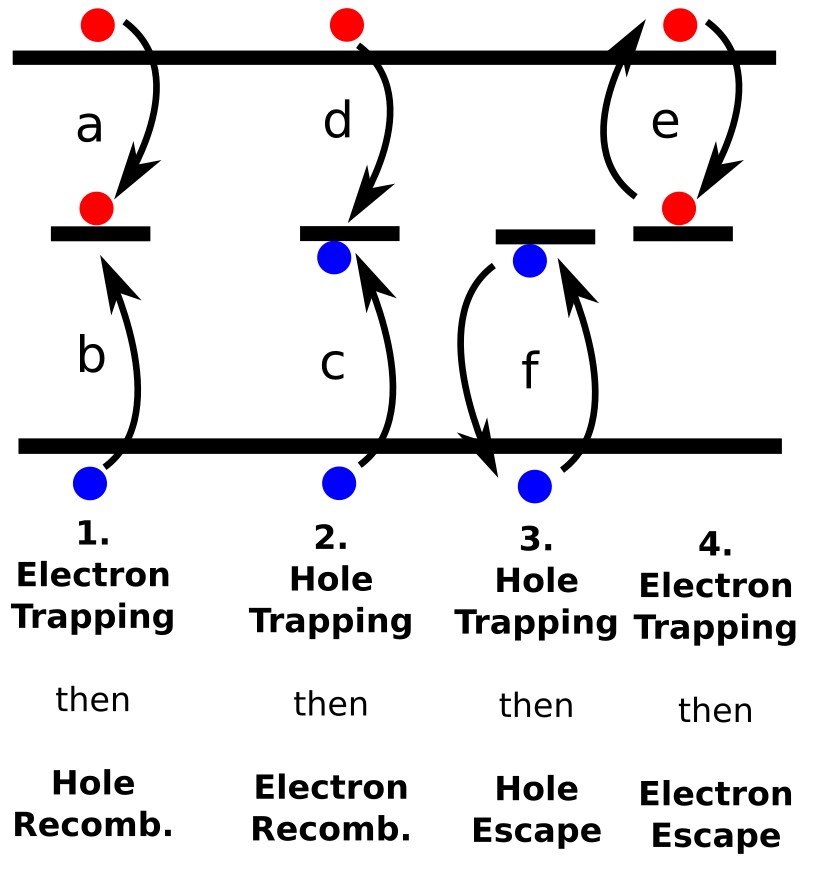
By analytically solving this equation under steady-state conditions, Shockley, Read, and Hall derived the classical SRH recombination expression given above. The derivation below starts from the fundamental assumptions of the SRH model and works systematically towards the steady-state recombination equation. Along the way, the transient or non-equilibrium form of the SRH equations naturally appears. This non-equilibrium form is the basis of the trapping model implemented within OghmaNano.
2. Capture and emission processes at a trap state
The Shockley-Read-Hall (SRH) model describes recombination through localized trap states within the semiconductor band gap. Consider a single trap level at energy \(E_t\), as illustrated in ??. This trap may exchange carriers with both the conduction and valence bands through capture and thermal emission processes.
An electron in the conduction band may relax into the trap state. Likewise, a hole in the valence band may also be captured through the trap. These capture processes correspond to carriers moving from a higher-energy state into a lower-energy localized state.
In contrast, a trapped carrier may also thermally escape back into a transport band. Electron emission requires a trapped electron to gain sufficient thermal energy to move from the trap level towards the conduction band edge. Similarly, hole emission corresponds to excitation from the trap level towards the valence band.
Processes which require carriers to move energetically uphill are thermally activated and therefore occur with Boltzmann-like probabilities proportional to
\[ \exp\!\left(-\frac{\Delta E}{kT}\right), \]
where \(\Delta E\) is the energy barrier which must be overcome. Large uphill energy barriers therefore suppress thermal emission exponentially. In contrast, carrier capture into a lower-energy trap state is energetically downhill and does not require thermal activation. Capture processes therefore do not contain an exponential suppression factor associated with overcoming an energy barrier.
As a result, deep traps tend to capture carriers efficiently while releasing them only slowly. Shallow traps, which lie closer to a transport band edge, exchange carriers with the bands much more rapidly.
The electron and hole capture coefficients are written as
\[ c_n=v_{th}\sigma_n \quad,\quad c_p=v_{th}\sigma_p, \]
where \(v_{th}\) is the thermal velocity, while \(\sigma_n\) and \(\sigma_p\) are the electron and hole capture cross-sections.
The thermal emission coefficients are written as
\[ e_n=v_{th}\sigma_n N_c \exp\!\left(\frac{E_t-E_c}{kT}\right) \]
\[ e_p=v_{th}\sigma_p N_v \exp\!\left(\frac{E_v-E_t}{kT}\right). \]
3. Trap occupation and SRH transition rates
The capture and emission coefficients above describe the transition probabilities associated with a single trap state. However, the actual transition rates also depend on whether the trap is occupied or empty.
Let the occupation probability of the trap be written as \(f\). Since the trap is a localized electronic state, its occupation follows Fermi-Dirac statistics under the assumption that carriers can thermally equilibrate within the trap energy distribution:
\[ f(E_t)= \frac{1} {1+\exp\!\left(\frac{E_t-E_F}{kT}\right)}. \]
The density of occupied traps is therefore
\[ n_t=N_t f, \]
while the density of empty traps is
\[ N_t(1-f). \]
Electron capture requires an empty trap state and is therefore proportional to \(1-f\). Hole capture requires a trap already occupied by an electron and is therefore proportional to \(f\). This occupation dependence is the key statistical feature of the SRH model.
The four elementary transition rates shown in ?? are therefore written as
\[ r_{ec}=c_n n N_t(1-f) \quad,\quad r_{ee}=e_n N_t f \]
\[ r_{hc}=c_p p N_t f \quad,\quad r_{he}=e_p N_t(1-f). \]
4. Transient trap occupation equation
The transient SRH equation is obtained by writing the rate of change of occupied traps. Electron capture fills a trap, electron escape empties it, hole capture empties it by recombination, and hole escape fills it by removing a valence-band electron. Therefore, using the notation of ??,
The derivation now continues by deriving the recombination rates which appear in the drift-diffusion continuity equations. These terms describe the net loss and gain of carriers between the conduction band, valence band, and the trap states through the SRH recombination processes derived above.
Since \(n_t=N_t f\), this is equivalently
\[ N_t\frac{df}{dt}=r_{ec}-r_{ee}-r_{hc}+r_{he}. \]
Substituting the four elementary rates gives
\[ N_t\frac{df}{dt} = c_n n N_t(1-f) - e_n N_t f - c_p p N_t f + e_p N_t(1-f). \]
Dividing by \(N_t\), the trap occupation equation becomes
\[ \frac{df}{dt} = c_n n(1-f) - e_n f - c_p p f + e_p(1-f). \]
This is the transient form of the single-level SRH model. It should be used when the trap occupation is itself a dynamic state variable, for example in transient simulations, slow trapping, trap filling, or non-equilibrium simulations where trapped charge contributes to Poisson’s equation.
The corresponding transient recombination terms are
\[ R_n=r_{ec}-r_{ee} = N_t\left[c_n n(1-f)-e_n f\right] \]
\[ R_p=r_{hc}-r_{he} = N_t\left[c_p p f-e_p(1-f)\right]. \]
Away from steady state, \(R_n\) and \(R_p\) need not be equal. Their difference changes the trapped charge density. At steady state, the trap occupation is constant and the two net rates become equal.
Connection to the drift-diffusion equations; the net recombination rates \(R_n\) and \(R_p\) derived above are fed directly into the electron and hole drift-diffusion continuity equations. See also: Drift-diffusion continuity equations .
See the transient SRH equations in action: to see these trapping equations solved explicitly for distributed trap states in a disordered semiconductor device, see: Modelling distributed trap states in disordered semiconductors .
5. Steady-state trap occupation
The remainder of this derivation is concerned with obtaining an analytical steady-state solution to the transient SRH rate equations derived above. By assuming that the trap occupation no longer changes with time, the coupled capture and emission processes can be reduced analytically to yield the classical Shockley-Read-Hall recombination equation used throughout semiconductor device physics and drift-diffusion modelling. To obtain the classical SRH recombination equation, we now assume steady-state trap occupation:
\[ \frac{df}{dt}=0. \]
The transient rate equation therefore gives
\[ r_{ec}-r_{ee}=r_{hc}-r_{he}. \]
This equality means that the net electron capture rate equals the net hole capture rate. In other words, in steady state the trap does not accumulate charge; it only mediates the recombination cycle shown in ??.
The thermal emission coefficients may be rewritten in terms of the equilibrium reference carrier densities \(n_1\) and \(p_1\):
\[ e_n=c_n n_1 \quad,\quad e_p=c_p p_1, \]
where
\[ n_1=N_c\exp\!\left(\frac{E_t-E_c}{kT}\right) \quad,\quad p_1=N_v\exp\!\left(\frac{E_v-E_t}{kT}\right). \]
The quantities \(n_1\) and \(p_1\) are equilibrium reference carrier densities associated with the trap energy. Physically, they encode the thermal activation barriers controlling electron and hole emission from the trap state.
Substituting \(e_n=c_n n_1\) and \(e_p=c_p p_1\) into the steady-state trap equation gives
\[ c_n n(1-f) - c_n n_1 f - c_p p f + c_p p_1(1-f)=0. \]
Collecting the terms proportional to \(1-f\) and \(f\),
\[ (1-f)(c_n n+c_p p_1) = f(c_n n_1+c_p p). \]
Solving for the occupied trap fraction gives
\[ f= \frac{c_n n+c_p p_1} {c_n(n+n_1)+c_p(p+p_1)}. \]
The empty trap fraction is
\[ 1-f= \frac{c_n n_1+c_p p} {c_n(n+n_1)+c_p(p+p_1)}. \]
6. Deriving the classical steady-state SRH equation
The steady-state SRH recombination rate can be written using either the electron balance or the hole balance:
\[ R_{\mathrm{SRH}}=r_{ec}-r_{ee}=r_{hc}-r_{he}. \]
Using the electron balance,
\[ R_{\mathrm{SRH}} = N_t\left[c_n n(1-f)-c_n n_1 f\right]. \]
Substituting the steady-state values of \(f\) and \(1-f\),
\[ R_{\mathrm{SRH}} = N_t c_n \left[ n \frac{c_n n_1+c_p p} {c_n(n+n_1)+c_p(p+p_1)} - n_1 \frac{c_n n+c_p p_1} {c_n(n+n_1)+c_p(p+p_1)} \right]. \]
The terms \(c_n n n_1\) cancel, leaving
\[ R_{\mathrm{SRH}} = \frac{N_t c_n c_p(np-n_1p_1)} {c_n(n+n_1)+c_p(p+p_1)}. \]
For a semiconductor in thermal equilibrium,
\[ n_1p_1=n_i^2. \]
Thus the classical steady-state Shockley-Read-Hall recombination rate becomes
\[ R_{\mathrm{SRH}} = \frac{N_t c_n c_p(np-n_i^2)} {c_n(n+n_1)+c_p(p+p_1)}. \]
Finally, defining the SRH lifetimes as
\[ \tau_n=\frac{1}{N_t c_n} = \frac{1}{v_{th}\sigma_n N_t} \quad,\quad \tau_p=\frac{1}{N_t c_p} = \frac{1}{v_{th}\sigma_p N_t}, \]
the standard textbook form is obtained:
\[ R_{\mathrm{SRH}} = \frac{np-n_i^2} {\tau_p(n+n_1)+\tau_n(p+p_1)}. \]
This final expression is the compact steady-state limit of the rate equation shown earlier. It contains the same capture and escape physics illustrated in ??, but with the trap occupation eliminated analytically.
7. Historical reference
The trap-mediated recombination model derived here is based on the statistical treatment introduced by W. Shockley and W. T. Read, Jr. in their 1952 paper on the recombination of holes and electrons in semiconductors. The derivation on this page is not a reproduction of the original text; it is a modern device-simulation derivation written using the rate notation used elsewhere in this manual.
See the transient SRH equations in action: to see these trapping equations solved explicitly for distributed trap states in a disordered semiconductor device, see: Modelling distributed trap states in disordered semiconductors .
Reference: W. Shockley and W. T. Read, Jr., “Statistics of the Recombinations of Holes and Electrons” , Physical Review, vol. 87, no. 5, pp. 835–842, 1952.