

Langevin Recombination
Langevin recombination is a bimolecular recombination mechanism commonly used to describe charge-carrier recombination in disordered semiconductors such as organic semiconductors, amorphous silicon and many thin-film materials.
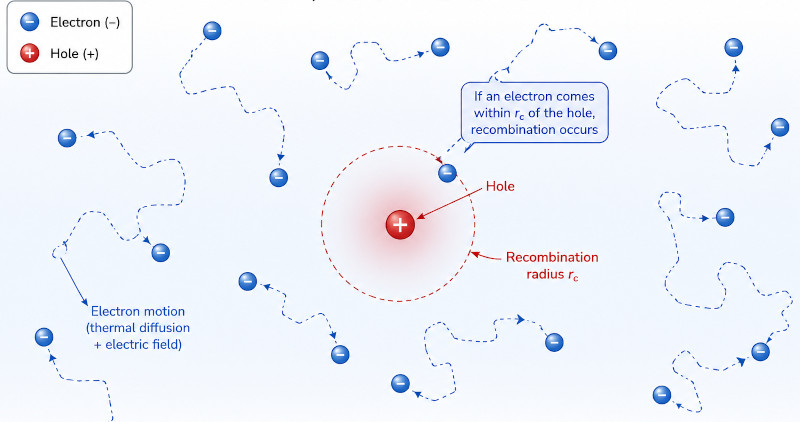
In the Langevin picture, recombination occurs because electrons and holes move through the semiconductor under the influence of thermal motion and electrostatic attraction. When an electron and hole approach sufficiently closely, the Coulomb attraction between them becomes strong enough that recombination occurs rapidly. This process is depicted in ??.
The key idea behind Langevin recombination is therefore that the recombination rate is limited not by the microscopic recombination event itself, but by the rate at which carriers can move through the material and encounter one another. It is therefore often referred to as a diffusion-limited or encounter-limited recombination process.
Because carrier motion is controlled by carrier mobility, Langevin recombination predicts that the recombination rate should scale directly with the electron and hole mobilities. Materials with low carrier mobility therefore tend to exhibit slower Langevin recombination rates.
Physical picture of Langevin recombination
Consider a hole surrounded by a sea of electrons (??) Electrons move through the semiconductor because of thermal energy and local electric fields. If an electron passes sufficiently close to the hole, the Coulomb attraction between the two carriers becomes larger than the thermal energy attempting to separate them.
Langevin defined a characteristic capture radius \(r_c\) (the red circle in ??), often called the Langevin recombination radius, at which the Coulomb interaction energy equals the thermal energy:
\[ E_{\mathrm{Coulomb}} = E_{\mathrm{thermal}} \]
Equating the Coulomb potential energy to the thermal energy gives:
\[ \frac{q^2}{4\pi \varepsilon r_c} = k_B T \]
Rearranging yields the recombination radius:
\[ r_c = \frac{q^2}{4\pi \varepsilon k_B T} \]
Inside this radius, Coulomb attraction dominates over thermal motion and recombination becomes highly probable.
The recombination radius increases as the dielectric constant decreases, meaning Coulomb attraction is stronger in low-permittivity materials such as organic semiconductors. This is one reason why Langevin recombination is particularly important in disordered organic electronic materials.
Derivation of the Langevin recombination rate
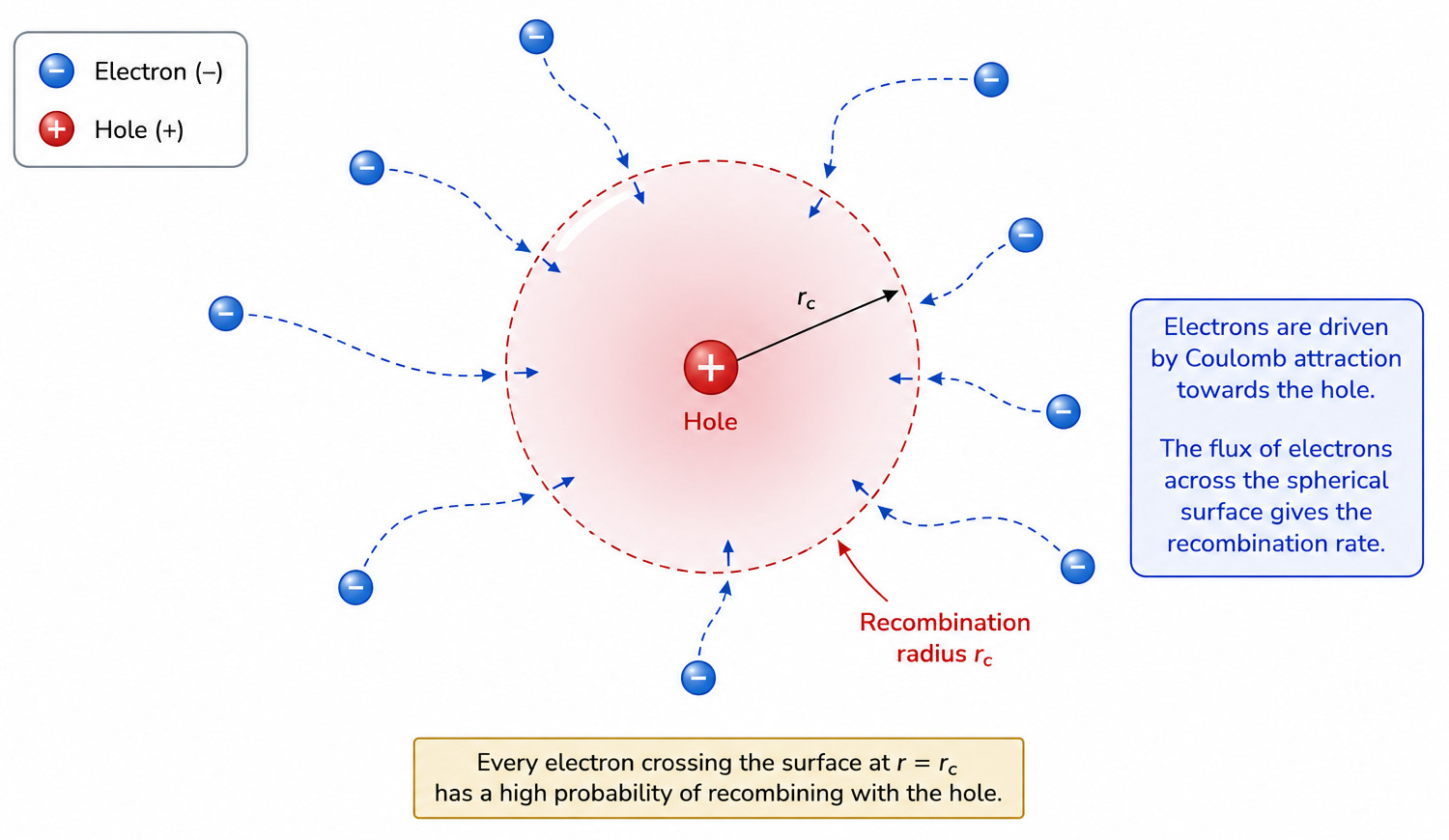
Langevin recombination can be derived by calculating the electron flux into the recombination sphere surrounding a hole (??)
The electron drift current density is:
\[ j_n = q n \mu_n E \]
where \(n\) is the electron density, \(\mu_n\) is the electron mobility and \(E\) is the electric field produced by the hole.
The Coulomb electric field surrounding the hole is:
\[ E(r)=\frac{q}{4\pi \varepsilon r^2} \]
Substituting this field into the drift current expression gives:
\[ j_n = q n \mu_n \frac{q}{4\pi \varepsilon r^2} \]
The total electron flux through the surface of a sphere of radius \(r\) is obtained by multiplying by the sphere area \(4\pi r^2\):
\[ I_n = j_n 4\pi r^2 \]
Therefore:
\[ I_n = \frac{q^2 \mu_n n}{\varepsilon} \]
An equivalent expression exists for holes:
\[ I_p = \frac{q^2 \mu_p p}{\varepsilon} \]
The total recombination rate is proportional to the probability of electrons and holes encountering one another, giving the Langevin recombination expression:
\[ R_{\mathrm{L}} = k_{\mathrm{L}} np \]
where the Langevin recombination prefactor is:
\[ k_{\mathrm{L}} = \frac{q}{\varepsilon}\left(\mu_n+\mu_p\right) \]
In many organic semiconductors one carrier mobility dominates, so the recombination rate is often approximately controlled by the slower carrier mobility.
Langevin recombination in disordered semiconductors

Langevin recombination is widely used in drift-diffusion simulations of disordered semiconductors because it naturally links recombination to carrier mobility.
In materials such as organic semiconductors, charge transport typically occurs through thermally activated hopping between localized states rather than transport through extended Bloch states as in crystalline silicon. Carrier mobility is therefore strongly dependent on energetic disorder, temperature and carrier density.
Because Langevin recombination depends directly on mobility, the recombination rate also becomes strongly dependent on these quantities. This behaviour is frequently observed experimentally in organic solar cells and OLED materials.
In drift-diffusion device simulations, the Langevin recombination rate is commonly included directly as a bimolecular recombination term:
\[ R_{\mathrm{L}} = \frac{q}{\varepsilon} \left( \mu_n+\mu_p \right) \left( np-n_i^2 \right) \]
Writing the recombination rate in the form \(np-n_i^2\) ensures that the net recombination rate becomes zero at thermal equilibrium.
Assumptions of the Langevin model
The standard Langevin recombination model contains several important assumptions:
- Recombination is encounter limited — the model assumes that once electrons and holes meet, recombination occurs immediately.
- Carriers behave as classical point charges — quantum-mechanical effects and wavefunction overlap are ignored.
- Transport is mobility limited — recombination is controlled entirely by the rate at which carriers move through the semiconductor.
- Homogeneous medium — the derivation assumes a spatially uniform semiconductor with a single dielectric constant.
- No explicit trap dynamics — trapping and de-trapping processes are not treated explicitly.
- Instantaneous recombination inside the capture radius — once carriers enter the recombination sphere, recombination is assumed to occur with unit probability.
These assumptions are often approximately valid in disordered semiconductors but may fail in systems with strong phase separation, deep trapping, carrier localization or interfacial recombination barriers.
Reduced Langevin recombination

Although Langevin theory successfully explains many features of recombination in disordered semiconductors, experimentally observed recombination rates are often significantly lower than predicted by the classical Langevin equation.
This behaviour is commonly referred to as reduced Langevin recombination. In practice, the recombination prefactor is often written as:
\[ k = \gamma k_{\mathrm{L}} \]
where \(\gamma\) is a reduction factor typically smaller than unity.
Several physical mechanisms can produce reduced Langevin recombination:
- Spatial separation of electrons and holes — electrons and holes may occupy different phases in bulk heterojunction materials.
- Carrier trapping — trapped carriers may become temporarily immobile, reducing encounter probability.
- Energetic disorder — carrier motion may become dispersive and non-classical.
- Interfacial barriers — recombination may require carriers to cross energetic or morphological barriers.
- Non-equilibrium transport — hopping transport in disordered materials may violate assumptions used in the classical derivation.
In organic photovoltaic devices, reduced Langevin recombination is frequently required to reproduce experimental current-voltage curves, transient photovoltage measurements and charge extraction experiments.
Where to go next
To see how Langevin recombination appears in practical device simulations, continue to the organic solar-cell recombination tutorial, where Langevin and SRH recombination are compared directly in drift-diffusion simulations.
For trap-assisted recombination mechanisms see Shockley–Read–Hall (SRH) recombination, and for the role of localized states in disordered materials see why trap states are needed in disordered semiconductor models.
The derivation of the drift-diffusion equations used together with Langevin recombination can be found in drift-diffusion theory.