

Cooke Triplet Lens Tutorial (Part B): Analysing Optical Performance
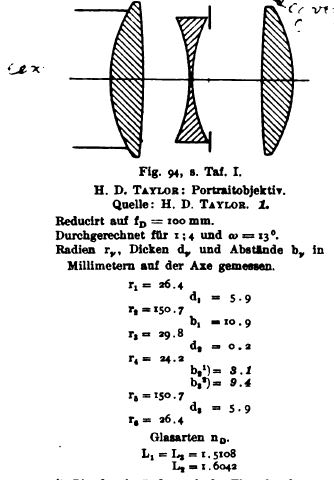
Introduction: Exploring aberrations with a narrow beam
In Part A we traced a broad beam through the Cooke Triplet and confirmed that the system forms an image on the detector, we also studied how the optical system attenuates certain wavelengths of light more than others. In this section we use a small beam with a reduced ray count to probe the imaging behaviour of the system. By restricting the spatial extent of the source, individual ray bundles remain distinct at the detector, allowing you to see how different regions of the pupil and different wavelengths map into spatial distortions in the image. As the source is moved off-axis, the evolving footprint directly exposes the underlying aberrations of the optical system. Two ideas to keep in mind as you work through this section:
- On-axis rays are rays that enter the lens close to its centre and travel straight through. They show how well the lens focuses light in the simplest case, where the object is directly in front of the lens. Any blurring or colour separation you see here comes from imperfections in how the lens bends light, even under ideal alignment.
- Off-axis rays come from points that are slightly to the side of the lens axis. These rays are responsible for image quality away from the centre of the picture. As you move further off-axis, distortions and colour shifts become more visible, revealing how the lens behaves toward the edges of the image.
Getting started
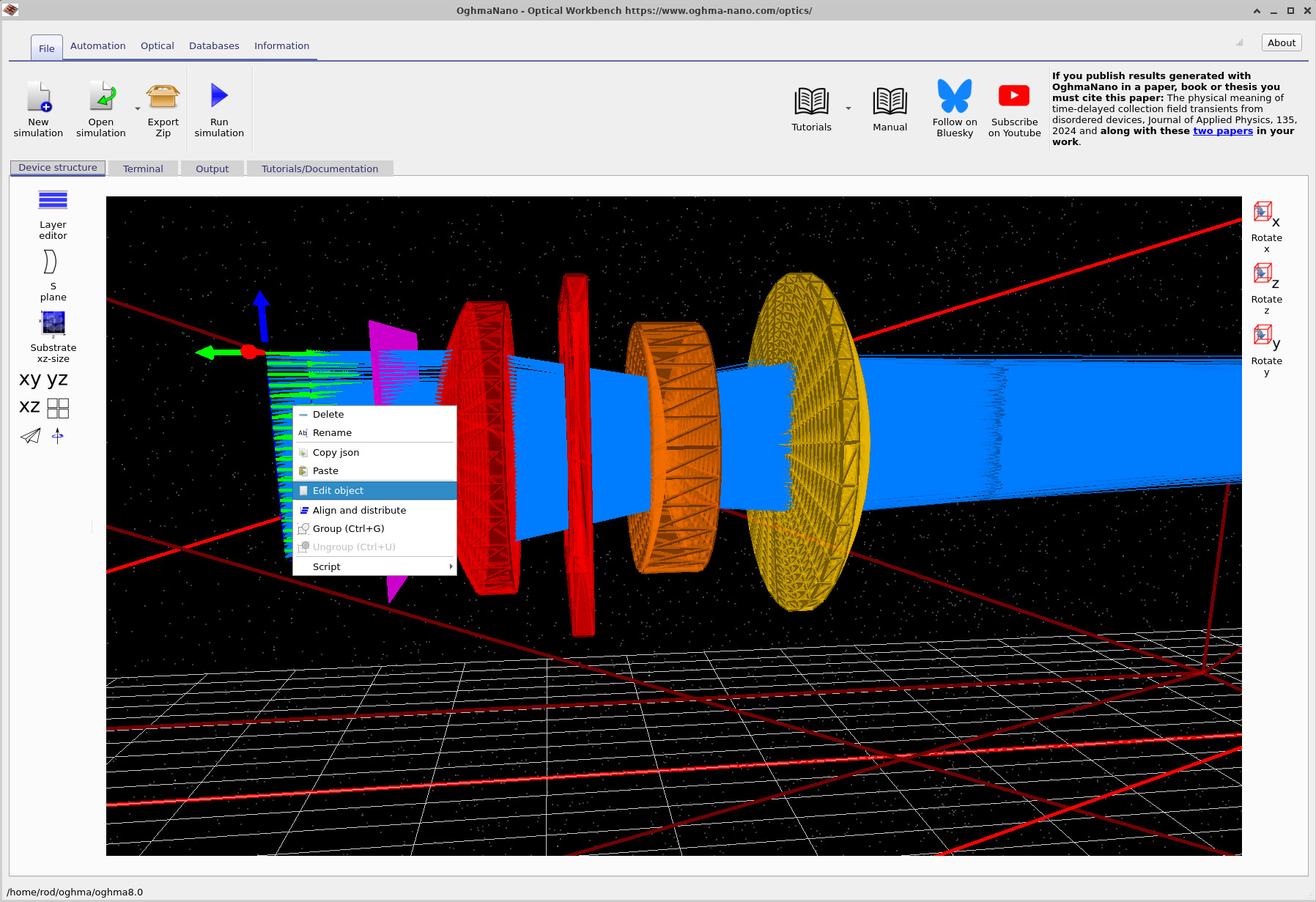
In the Device structure view, right-click on the green light source and choose Edit object, as shown in ??. This opens the Light source editor where we can control (i) the physical size of the emitting patch and (ii) how many rays are launched across that patch.
In the Object tab
(??),
set dx = 0.25 cm and dy = 0.25 cm.
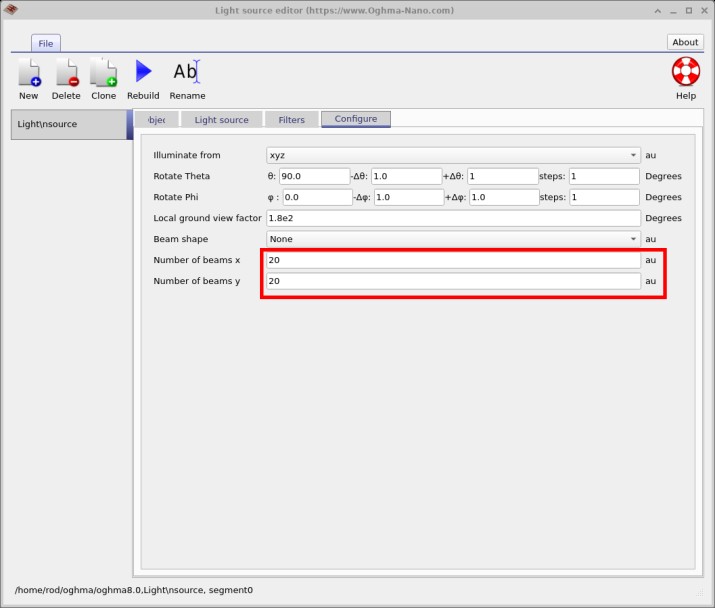
You can leave dz unchanged (the source is a 2D sheet in this setup). Now switch to the Configure tab
(??)
and set Number of beams x = 20 and
Number of beams y = 20.
This gives a sparse but informative sampling: enough rays to show the shape of the spot, without turning it into a solid blob.
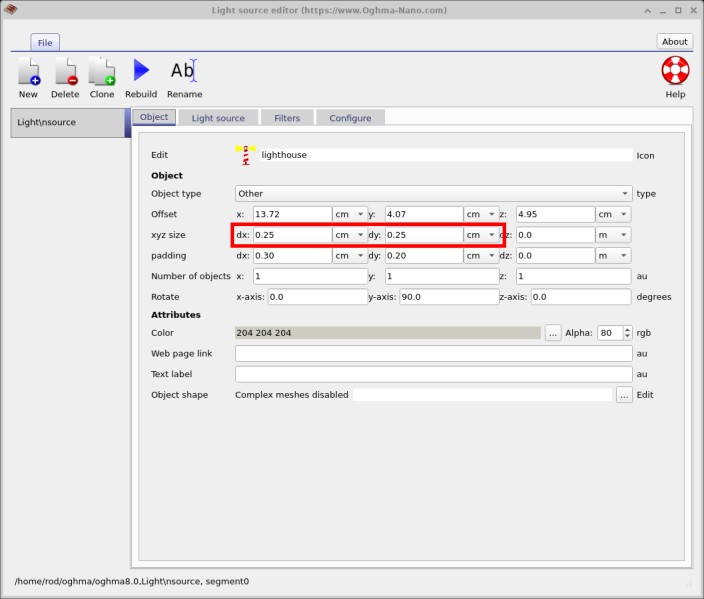
dx and dy to create a compact source patch.
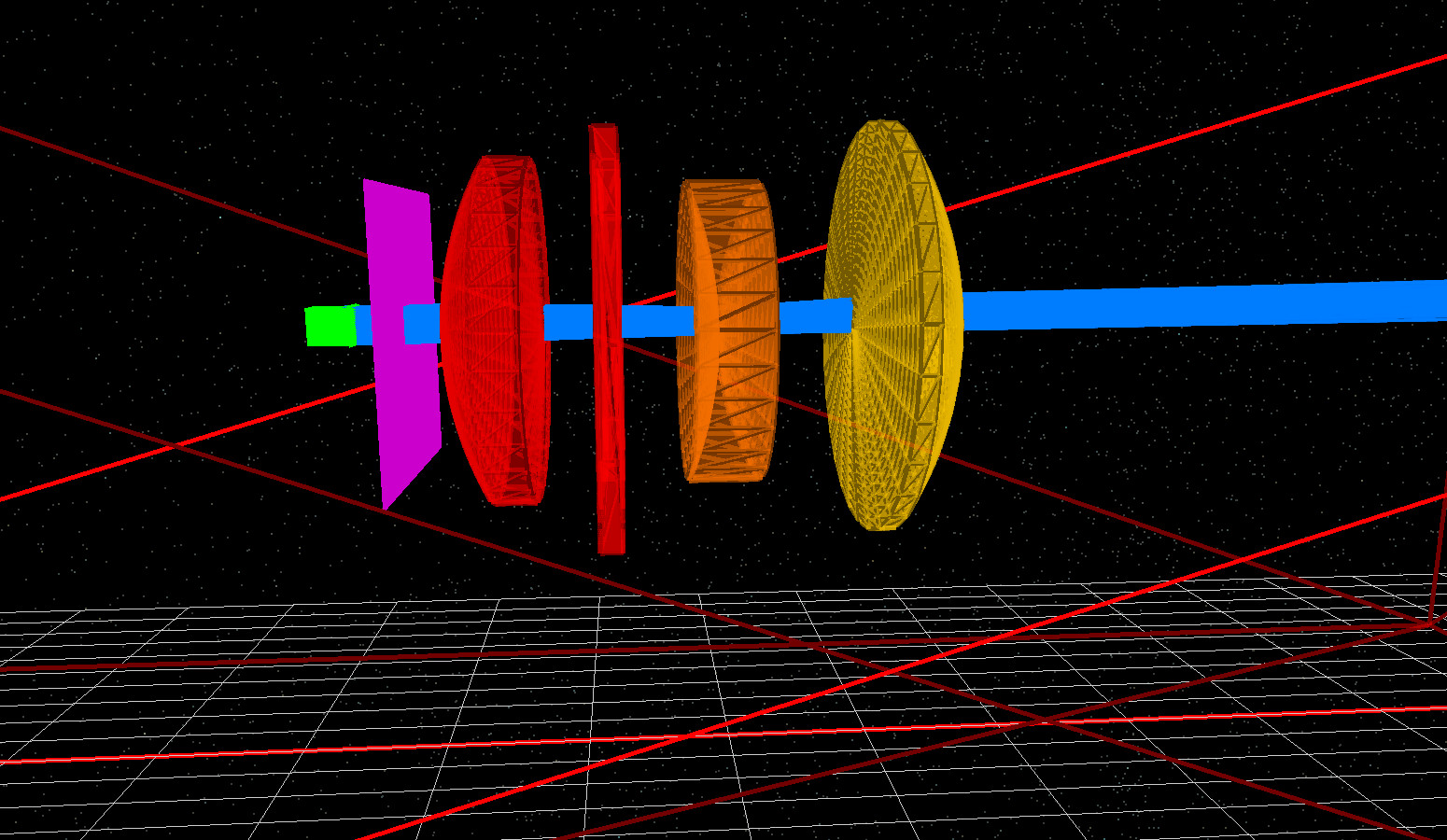
Close the editor and rotate the 3D view so you can see the source, the three lenses, and the detector in one line. Position the light source so the narrow beam enters the centre of the first (red) element, as shown in ??.
Click Run simulation, then open the Output tab, navigate to detector0, and
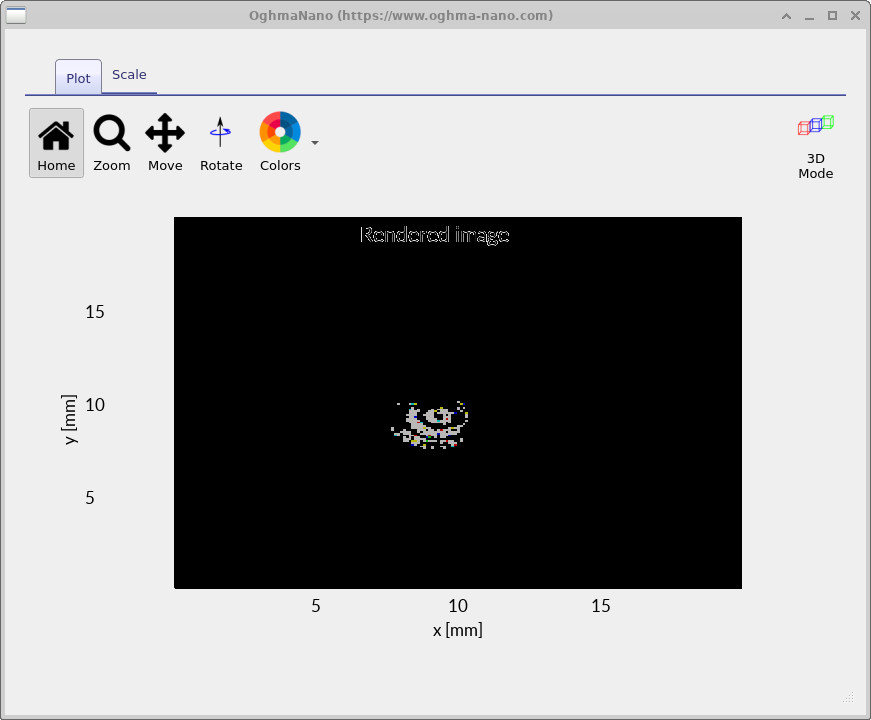
open RAY_image.csv to view the on-axis spot diagram
(??).
When the source is placed directly in front of the lens (on-axis), the light arrives at the detector as a small, roughly circular cluster. Even in this simple case, the image already tells you several important things about how the lens is focusing light.
- How spread out the light is: the light does not fall onto a single pixel, but forms a small patch. This means the detector is not positioned at a single perfect focus for every ray. Some spreading is normal, because the source has a finite size and real lenses never bring all rays to exactly the same point.
- The overall shape of the patch: the cluster is mostly round rather than stretched in one direction. This is a good sign on-axis and indicates that the lens is focusing light in a balanced way. Strong elongation here would usually suggest poor alignment or that the detector plane is far from the best focus position.
- How different colours line up: the coloured points sit close together but do not overlap perfectly. This shows that different colours focus at slightly different depths inside the lens. Because the detector is fixed in one position, this appears as small colour separation within the spot.
Off-axis aberrations: Field shift, coma and astigmatism
We now move the light source slightly away from the centre of the lens. This tests how the lens forms images away from the middle of the picture. Optical aberrations are imperfections in how a lens bends light, and they become more noticeable as you move toward the edges of an image. Instead of forming a neat, round spot, the light often spreads out unevenly, producing an asymmetric blur that has a clear direction or shape.
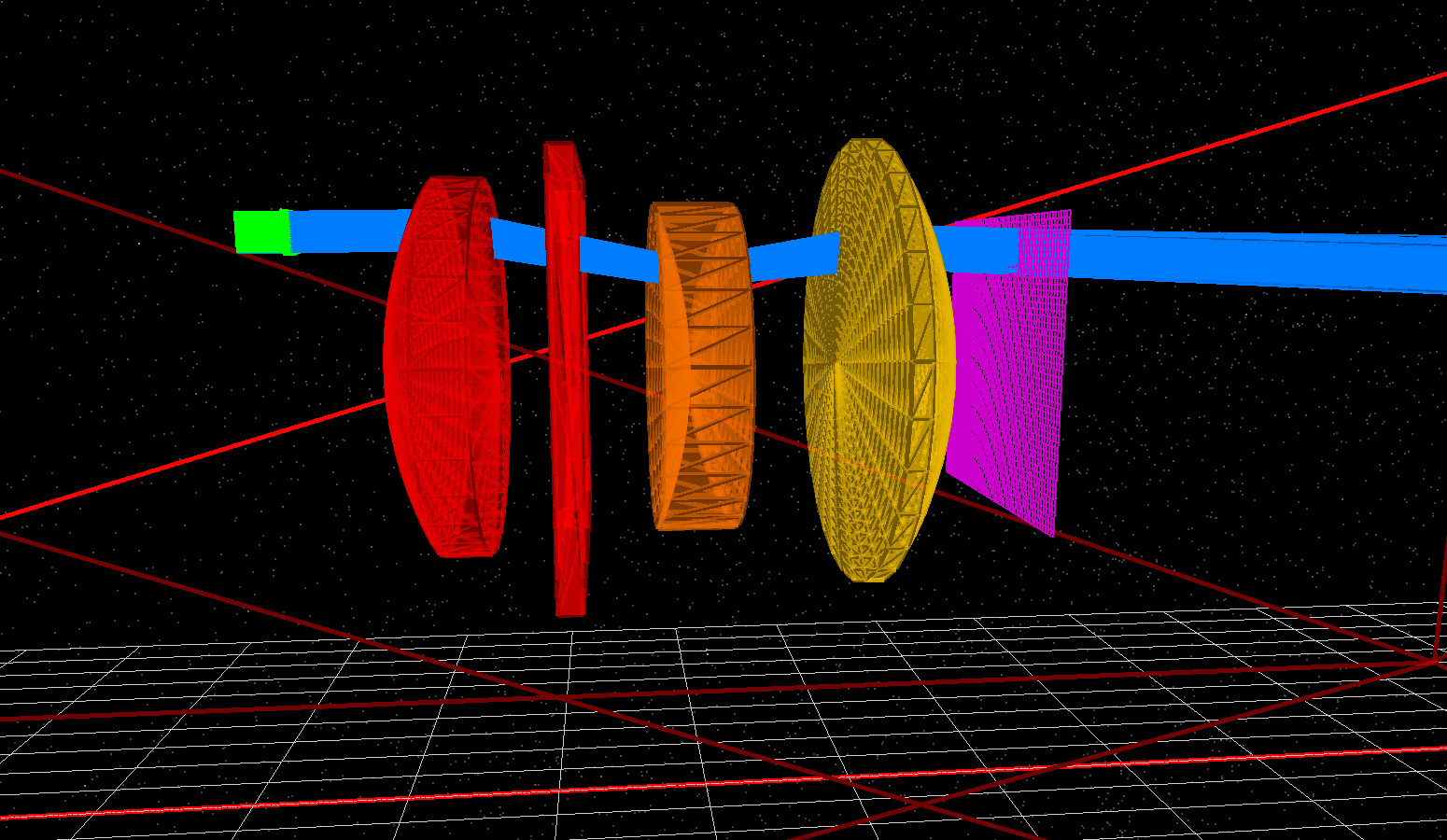
In the 3D view, drag the light source upward so that it no longer shines through the centre of the first lens, as shown in ??. Keep the beam pointing in the same direction. This creates an off-axis field point, meaning we are imaging a point that lies away from the centre of the scene, rather than tilting the camera or changing where it points.
Run the simulation again and reopen RAY_image.csv in detector0
(??).
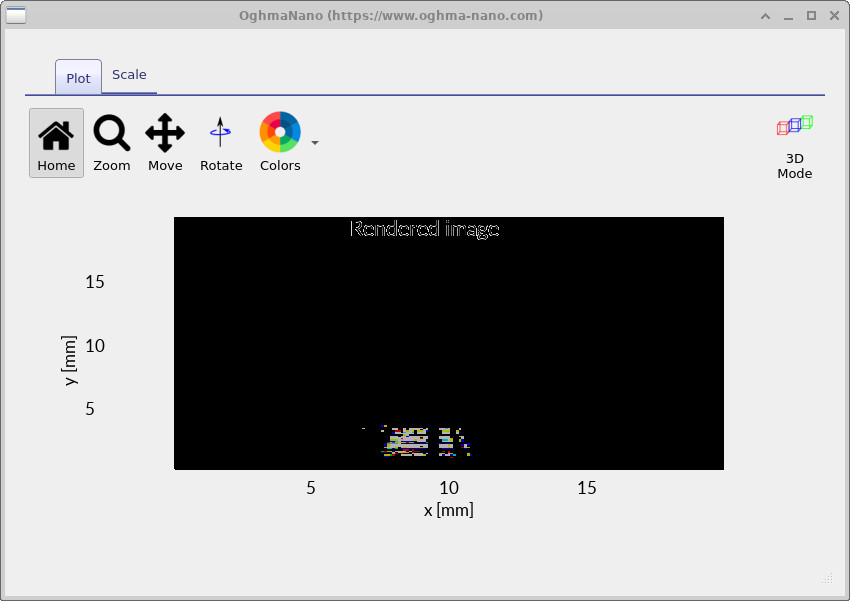
Compared with the on-axis result, three changes should jump out immediately:
- Field shift: the spot is no longer centred in the detector image. Even if the lens forms a sharp image, an off-axis field point maps to a different position on the detector. This displacement is expected and is part of normal imaging geometry.
- Coma (asymmetry): the footprint becomes noticeably one-sided rather than round. In practical terms, coma means different pupil zones “miss” the ideal image point by different amounts, so the spot gains a bright core plus a smeared, directional halo instead of a symmetric blur.
- Astigmatism / field curvature (directional spread): the off-axis spot is stretched more strongly along one direction. This is the usual sign that tangential and sagittal ray bundles would prefer different best-focus planes. At the fixed detector plane, one direction appears closer to focus while the orthogonal direction is still defocused.
You can also see that the colour separation is larger off-axis. This is lateral chromatic aberration: different wavelengths land at slightly different lateral positions in the image plane, which shows up as coloured streaking within the spot. In a well-corrected photographic lens this is controlled (not eliminated), and it typically becomes more noticeable towards the edge of the field.
The key takeaway is that the Cooke Triplet is behaving like a real historical photographic design: good central performance, and then a progressive increase in coma/astigmatism/colour errors as you move off-axis. This is exactly what makes it a useful teaching example: you can see the “textbook” aberrations appear with only a simple source shift.
What you can now do (Part B) - diagnose aberrations
- Create readable spot patterns by shrinking the source patch and reducing ray count.
- Compare on-axis vs off-axis cases to reveal how aberrations grow with field position.
- Name what you see: field shift (spot moves), coma (asymmetry), astigmatism/field curvature (directional spread), and lateral colour (wavelength-dependent displacement).
Core idea: a narrow beam turns “image quality” into a geometric fingerprint — the spot shape is a direct map of how different ray bundles miss the ideal image point.
Rule of thumb — what changes first as you go off-axis?
- Position changes first (field shift): the image point moves across the detector.
- Symmetry breaks next (coma): one-sided blur develops.
- Orthogonal focus separates (astigmatism/field curvature): spot stretches more in one direction.
- Colours diverge (lateral colour): different wavelengths land at different lateral positions.
👉 Next steps: Continue to Part C, where we introduce aperture stops and explore how limiting the pupil changes ray paths, spot size, and overall image quality.
For an overview of optical systems and ray-tracing simulations, see Optical systems and ray tracing overview.